

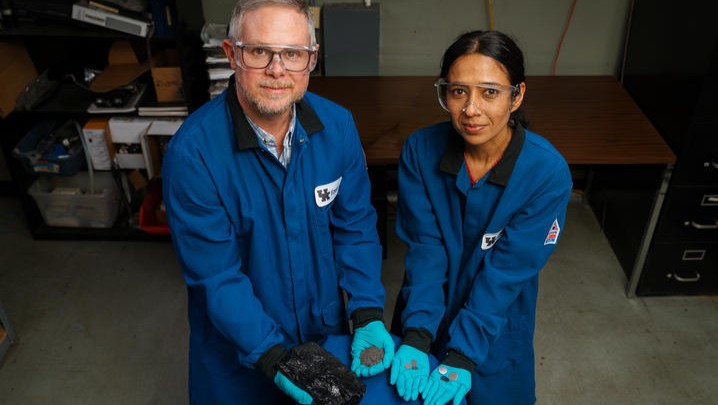
LEXINGTON, Ky. — Coal has long been the fuel at the heart of energy production in the Commonwealth. Kentuckians often grow up with stories of their grandfather’s days in the mines. But researchers at the University of Kentucky are finding ways to repurpose coal for energy storage — in the form of lithium-ion batteries.
Matthew Weisenberger, Ph.D., an associate director at the UK Center for Applied Energy Research (CAER) and adjunct assistant professor in the Stanley and Karen Pigman College of Engineering, is at the forefront of this effort, spearheading research into converting coal into synthetic graphite. Weisenberger’s research is creating a domestic, competitively priced supply of a material that is increasingly essential to modern life.
“Everything has a battery in it now,” Weisenberger noted. Rechargeable lithium-ion batteries are ubiquitous in electronic devices these days, from phones to tools to vehicles. They work by storing and moving lithium ions from one material to another, and while “lithium” is the element that gives the battery its name, there is often 10-15 times more graphite than lithium in a fully functioning battery.
“On average, an EV battery requires about 165 pounds of graphite,” Weisenberger said.
Currently, the global supply chain for this material is heavily concentrated, with 90 percent of battery-grade graphite originating in China. This creates significant trade and political challenges for U.S. manufacturers.
“The Chinese graphite is quite good, and it is very low cost,” Weisenberger said. “So we’re working on generating low-cost domestic synthetic graphite.”
Battery-grade graphite requires extreme purity — specifically 99.999 percent carbon. This level of refinement from natural mined sources, like those from China, often involves hazardous chemical processes, such as the use of hydrofluoric acid to dissolve silicates from mined graphite.
Weisenberger’s team is reaching those levels of purity by combining Kentucky’s most storied energy resource with derivatives of petroleum waste to create a cleaner, highly crystalline material.
From seed to harvest
What sets the UK Center for Applied Energy Research apart from other research facilities is its ability to manage the entire development cycle in a single location.
“We have here, under one roof, the capacity to take an earth resource like coal, process that through to a synthetic graphite, fabricate and integrate that into lithium-ion batteries and then test those batteries,” Weisenberger said.
This comprehensive approach allows researchers to span a wide gap between raw resource extraction and final technology testing. The facility includes a specialized dry room where the processed graphite is turned into electrodes and integrated into lithium-ion cells by researchers like Aman Preet Kaur, Ph.D., senior research scientist at CAER.
From there, the team can conduct rigorous quantitative testing, measuring performance metrics such as irreversible and reversible capacity, charge/discharge efficiencies at varying rates, and how the batteries hold up over hundreds of charge and discharge cycles.
A 39 percent breakthrough in yield
The economics of the process are compelling. Traditional synthetic graphite precursors, such as FCC decant oil, a by-product from petroleum refining, cost approximately $400 a ton. In contrast, coal is available for roughly $100 a ton.
Weisenberger’s team has focused on a process called direct coal liquefaction to capitalize on this price difference. In this method, powdered coal is blended into a slurry with decant oil and heated to 400 degrees Celsius at 300 pounds per square inch for 30 minutes.
The results have been promising. The team has shown that this blended pathway can generate 39 percent more graphite than using FCC decant oil alone.
“We’re really excited about that,” Weisenberger said, adding that the resulting graphite performs just as well in batteries as the petroleum-only baseline.
Beyond liquefaction, the team is also exploring catalytic graphitization, a parallel path that converts solid coal into crystalline graphite at lower temperatures using a solid catalyst. This path could eventually offer an even more efficient engineering solution by reducing the number of steps required for conversion and increasing the coal precursor utilization to 100 percent.
The whole buffalo
Although Weisenberger’s group focuses on the carbon fraction of the coal for graphite, they are also collaborating with Rick Honaker, Ph.D., a professor of mining engineering in the Pigman College of Engineering, whose team focuses on the mineral matter left behind. This byproduct is often enriched with rare earth elements.
Rare earth elements are used to create high-performance magnets, electronic displays, optical lenses, radar, sonar, lasers and other advanced technologies.
“We select a coal that has mineral matter that is relatively concentrated in rare earth elements,” Weisenberger explained. “Here, we convert the coal to synthetic graphite for batteries while leaving this mineral matter for downstream processing to rare earth ore. Both products are far more valuable than the parent coal source.”
This production synergy, funded by the Department of Energy, ensures that the mineral fraction is enriched for rare earth elements while the carbon fraction powers the batteries of the future. This total-utilization strategy is central to making the technology economically viable at a commercial scale.
Commonwealth of the future
Although portable electronics and EVs remain primary drivers, the demand for graphite is also being fueled by a massive increase in Battery Energy Storage Systems (BESS).
Residential BESS systems allow homeowners to store energy for use during grid outages, like many parts of the state experienced during this winter’s ice storms. As the world moves toward more decentralized energy grids, these large-scale batteries are becoming a staple of modern infrastructure.
From smartphones to home backup systems, the ubiquity of these devices ensures that the demand for high-purity, domestically produced graphite will only continue to climb. And the goal of the Center for Applied Energy Research is for Kentucky to be at the forefront.
“This research is a bridge between Kentucky’s leadership in energy production and its future as a hub for advanced materials,” said Rodney Andrews, Ph.D., director of CAER and a professor of chemical engineering in the Pigman College of Engineering. “By transforming coal into high-value synthetic graphite, we are ensuring that Kentucky’s resources and workers remain at the center of the transition.”
CAER recently demonstrated its leadership position in this technology while hosting its third annual industry roundtable meeting on graphite, convening the United States’ major manufacturers and supply chain stakeholders to identify common national needs. More than 60 international experts met at Kroger Field on April 21 to discuss the future of minerals.
By finding a high-tech use for coal as its role in energy production decreases and positioning UK as an innovator in the field, Weisenberger and his team are helping to secure a new economic chapter for the state.
“The process that’s going to win is the one that’s economically viable,” Weisenberger said. The team at CAER hopes that Kentucky’s natural resources and UK’s unique research infrastructure help make coal-to-graphite that winning process.