

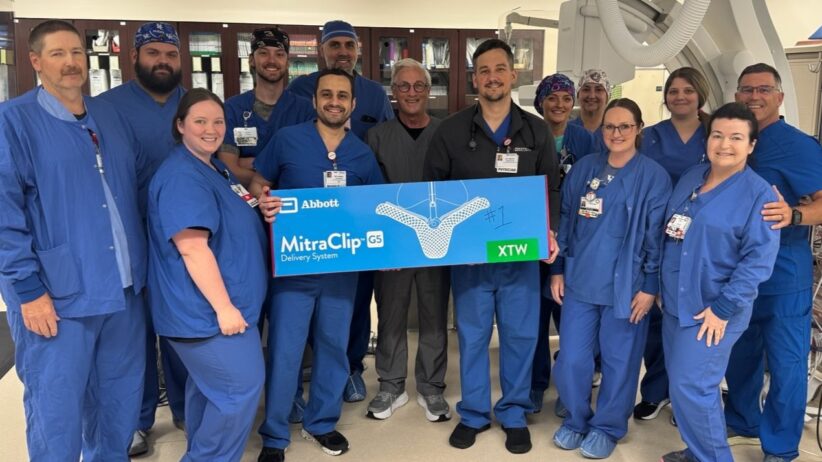
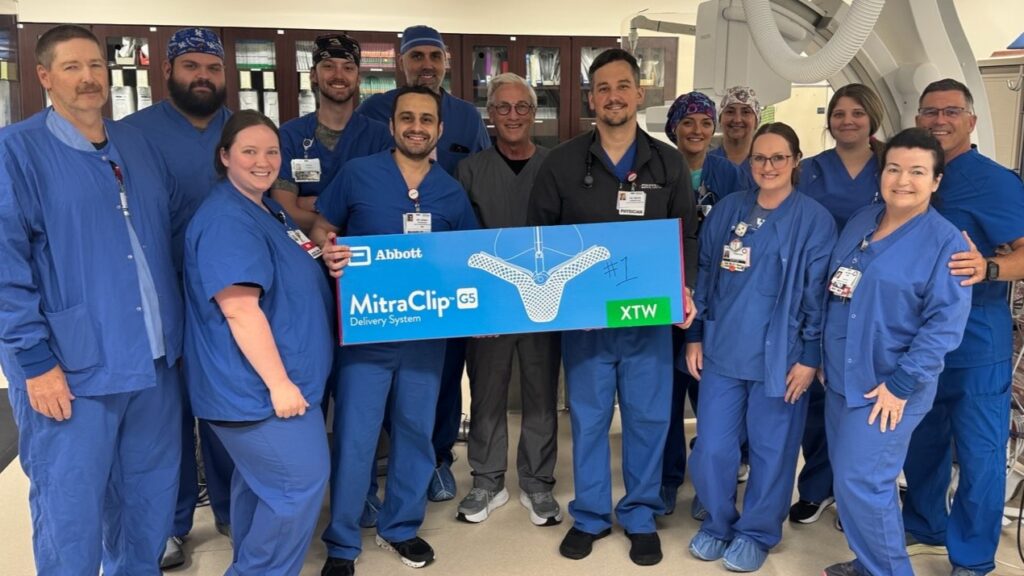
PIKEVILLE, Ky. – Pikeville Medical Center is proud to announce the successful completion of its first solo MitraClip procedure.
The groundbreaking, minimally-invasive procedure was performed by Maen Assali, MD, an interventional cardiologist at the Heart & Vascular Institute of Eastern Kentucky, offering a new, life-changing treatment option for patients with severe mitral regurgitation who are considered too high-risk for open-heart surgery.
MitraClip is one of the world’s first mitral transcatheter edge-to-edge repair therapy, also referred to as TMVr, or transcatheter mitral valve repair, that delivers a minimally invasive treatment option for select patients. It is a well-established procedure with more than 20 years of clinical use and over 200,000 patients treated globally. MitraClip has the highest reported-to-date MR reduction.
Mitral regurgitation is a condition in which the heart’s mitral valve leaflets do not close tightly, causing blood to leak back into the heart. If left untreated, it can lead to heart failure and other serious cardiac complications. The MitraClip device repairs the leaky valve without the need for a heart-lung bypass machine or a large chest incision.
“The successful launch of our independent MitraClip program marks a major milestone for Pikeville Medical Center and the patients we serve throughout the region,” Dr. Assali said. “While this marks our first procedure performed completely on-site by our local team, our program is uniquely backed by a collaborative partnership with leading structural heart specialists from Cincinnati. This gives patients throughout the community access to university-level expertise without the stress of traveling. For those with severe MR who aren’t candidates for open-heart surgery or would respond better to non-surgical options, we can now offer a life-changing, minimally invasive solution close to their families. Because this technique is minimally invasive, most patients can go home the next day.”
During the procedure, Dr. Assali attached a small clip to the patient’s mitral valve leaflets, helping it close more completely and restore normal blood flow. The procedure typically takes one to three hours and allows for a shorter recovery time than open heart surgery. Patients who undergo the procedure are twice as likely to see major improvements in quality of life compared to medication alone.