
SARAH ANN, W.Va. — The Hatfields and McCoys Historical Society is sponsoring three free events to help Appalachian residents connect with their ancestry, heritage, and a famous feud that nearly divided America.
The nonprofit organization is sponsoring two exhibits from the West Virginia Humanities Council during May and June. It will be capped off with a somber wreath-laying ceremony and the awarding of a scholarship to a rising high school senior from noon to 2 p.m. Monday, May 25, at the Hatfield Family Cemetery.
“Memorial Day holds a profound, layered significance in Appalachia that goes far beyond a three-day weekend,” said William K. “Billy” Hatfield, president of the organization. “In this region, the holiday isn’t just about national service; it’s a deeply personal ritual that intertwines military sacrifice with a fierce devotion to family lineage.”
Long before the official federal holiday, many Appalachian communities practiced (and still practice) Decoration Day. Historically, this was a specific Sunday in late spring or early summer when families gathered at small, often remote, ridge-top cemeteries.
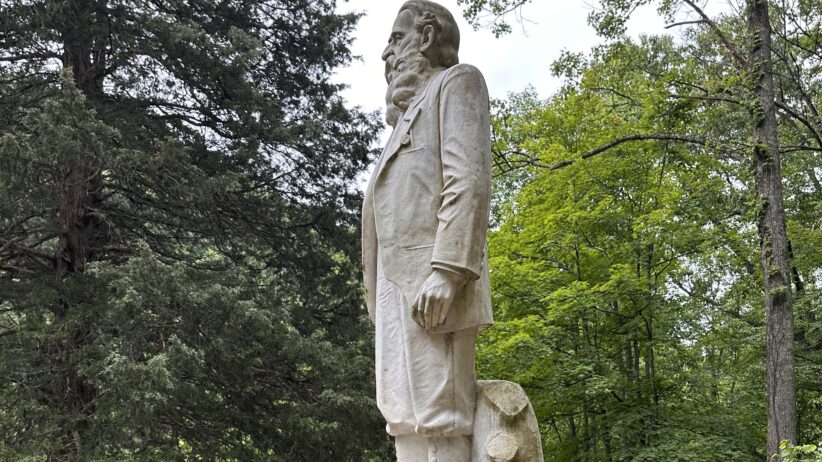
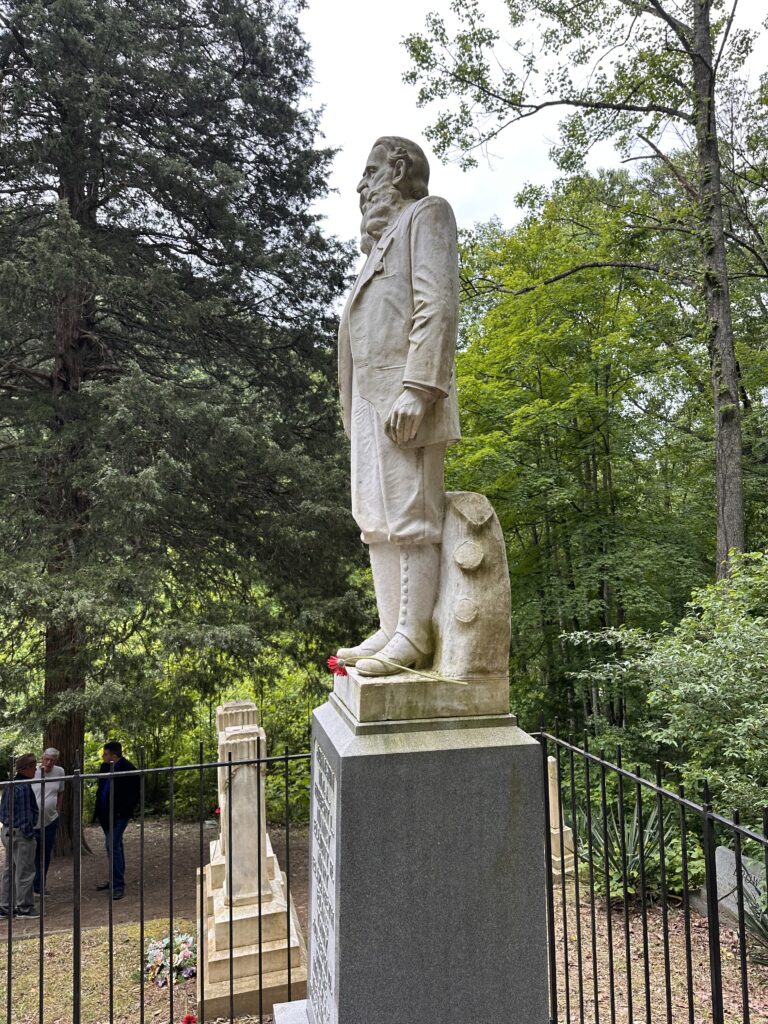
William K. Hatfield is a great-grandson of patriarch William Anderson “Devil Anse” Hatfield. “Devil Anse” is memorialized with a life-size marble statue at the family cemetery. It is on the National Register of Historic Places.
The two displays, “American Blood Feud: The Hatfields and McCoys” and “Born of Rebellion,” will be available:
- May 24-June 1, Chief Logan Lodge & Conference Center, 100 Conference Center Drive, Logan, W.Va. ( 6 a.m.-10 p.m. daily)
- May 16-22, Larry Joe Harless Center, 202 Larry Joe Harless Dr, Gilbert, W.Va. (8 a.m.-8 p.m. Monday-Friday, noon- 8 p.m. Saturdays, noon 5 p.m. Sundays)
- Noon-2 p.m. Monday, May 25, The wreath-laying ceremony is set for the Hatfield Family Cemetery at Sarah Ann. (Coordinates: 37°42′15.23″N 81°59′32.01″W / 37.7042306°N 81.9922250°W)
During the event, the recipient of the $1,000 2026 Hatfield Scholarship will be announced.
“American Blood Feud: The Hatfields and McCoys” traces the history of events that have become synonymous with the word “feud.”
“Born of Rebellion” spans a century of history, from the growing divide between eastern and western Virginia in the early 1800s, to the battlefields in West Virginia hills, and beyond. Visually rich sections cover the lead-up to war, military actions in the future Mountain State, the political path to statehood, the experiences of women and Black West Virginians, and postwar memory and memorialization.
The Civil War didn’t start the Hatfield-McCoy feud, it acted as a tinderbox that made the subsequent explosion inevitable. The conflict between the two families was deeply rooted in the shifting loyalties, guerrilla warfare, and post-war bitterness of the 1860s.
The feud played out on the border of West Virginia (Union) and Kentucky (Confederate-leaning, though officially neutral then Union-controlled).
Led by William Anderson “Devil Anse” Hatfield, they were staunch Confederates. Devil Anse served in the Confederate Army and later led a guerrilla group called the “Logan Wildcats.”
Led by Randolph “Ole Ran’l” McCoy, the family was generally more aligned with the Union, though the lines were often blurred.
The Civil War provided the “inciting incident” for the violence. In 1865, Asa Harmon McCoy — Randolph’s brother — returned home after serving in the Union Army.
Because he had fought for the north, he was viewed as a traitor by local ex-Confederates. Shortly after his return, he was found murdered in a cave. While it was never legally proven, the community widely believed that the Logan Wildcats (Devil Anse’s group) were responsible. This created a deep-seated resentment that simmered for over a decade before the famous “stolen pig” trial of 1878.
The war turned the Tug River Valley into a “no man’s land.” Because the region was rugged and remote, formal military presence was scarce, leading to the rise of bushwhackers — guerrilla fighters who used the war as an excuse for private robbery and revenge.
When the war ended, these men didn’t just go back to farming; they remained armed, traumatized, and highly suspicious of their neighbors.
The war weakened local government structures, meaning that when disputes arose later, families often defaulted to “mountain justice” rather than the courts.
The war also created an economic divide. Devil Anse Hatfield used his wartime connections and aggressive tactics to build a successful timber empire after the war. The McCoys, conversely, struggled significantly. This “nouveau riche” vs. “struggling neighbor” dynamic added a layer of class resentment to the pre-existing political bitterness.
The Civil War turned neighbors into enemies and provided a violent precedent for settling scores. By the time the families began fighting over a hog in 1878, they weren’t just arguing about livestock; they were reopening wounds from a war that had ended 13 years prior.
“College is a significant burden to students, especially first-time college students,” said William K. Hatfield, president of the organization. “We help by providing financial assistance through our essay competition.”
The Hatfield-McCoy feud began in the Tug River valley’s remote crags, the river separating West Virginia and Kentucky. The river also separated the loyalties of two divided families.
The Hatfields and McCoys are famous for their legendary, decades-long feud in the Appalachian region that became a symbol of violence, family loyalty, and retribution. It is part American folklore.
William Anderson Hatfield, known as “Devil Anse,” was the recognized leader of the Hatfields. Randolph “Old Randle” McCoy was the leader of the McCoys.
Caption The statue of Hatfield patriarch Devil Anse Hatfield stands guard at the mountainside cemetery at Sarah Ann, West Virginia. It is on the National Register of Historic Places. Photo by Emery Jeffreys